Articles By Lorraine Barton

AICPA and Partners Develop New Valuation Credential

The American Institute of CPAs has partnered with the American Society of Appraisers and the Royal Institution of Chartered Surveyors on a new credential for financial professionals who provide fair value measurement services.
The AICPA, ASA and the RICS began working together on developing a single credential that offers a more consistent framework for fair value measurement. The organizations are striving to be sure financial professionals have the necessary training, qualifications, experience and expertise to perform the work. They released a proposed framework in 2016.

Financial professionals who receive the new Certified in Entity and Intangible Valuations (“CEIV”) credential would need to follow new uniform guidance on how much documentation is necesssary to support their fair value measurement results in company financial statements when they are producing valuations of entities and intangible assets such as trademarks, patents and technology, customer sales lists, and non-compete agreements.

The uniform guidance for the credential specifies the level of documentation necessary to enable investors, auditors and regulators to understand more easily how fair value measurement has been used to determine the values of businesses and intangible assets. The CEIV credential also requires regular monitoring of credential holders to make sure they’re following the new guidance.

To get the new credential, financial professionals need to meet certain eligibility requirements determined by the AICPA, ASA and the RICS, in collaboration with the Appraisal Foundation and the International Valuation Standards Council, which also helped develop the new credential. Those requirements include demonstrating competencies in valuation and fair value measurement through training and assessments, along with passing a two-part CEIV exam that will be introduced this year.

We here at Advent are always trying to proactively respond to clients’ needs and are watching the developments closely and, if necessary, will be obtaining the new credential.

Porter: The Five Competitive Forces That Shape Strategy

In 1979 Michael Porter wrote an article that was published in the Harvard Business Review, entitled, “How Competitive Forces Shape Strategy.” He subsequently published an expanded discussion on this in a published work in 1981.

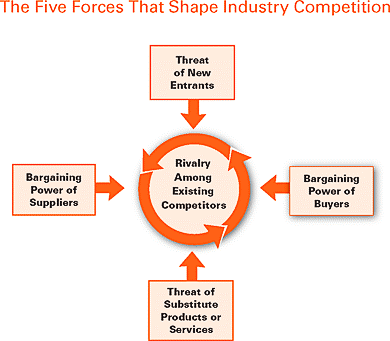
Porter proposed that the competitive environment can be analyzed through a five factor categorization (rivalry amongst existing competitors, threat of new entrants, etc. – see below) and suggested that companies respond in one of three ways – cost leadership; differentiation from competitors; or focus on market segment(s).

Essentially competitive pressure on a business can come from either vertical relationships or horizontal relationships, as well as from direct competitors. The more a business owner understands the forces, the better equipped the business owner is to not only respond, but proactively act against these competitive forces.

The Harvard Business Review published Mr. Porter’s revisit to the subject in its January 2008 edition, entitled, “The Five Competitive Forces That Shape Strategy.” A link to a thirteen minute online video of Porter describing his updated article is available here.

Why has Porter’s model endured? Because it is a simple, yet comprehensive way to analyze and understand the competitive environment in which a company operates. If we can understand our competitive environment, we can develop effective strategies to compete against our competitors – selling more and better margins. Who doesn’t want that?

Key Insights from a Business Valuation

The nature of the business valuation environment requires us to remain independent and report on our opinion of value as an objective third party. However, there are times when we are engaged to consult with a client to help identify the specific value drivers of a business and estimate its range of value for the owners. In either case, business owners and their trusted advisors can glean from the insight gained from performing a valuation. Sometimes it takes an objective third party assessment to see things from a different perspective and reveal new insights about a business.

We recently valued a small family owned parts supplier. The majority owner and manager of the business wanted to buy out his sibling pursuant to their buy-sell agreement. The business had been in the family for over 50 years. It owned the real estate where it was located, which was on a busy street in New York City. Behind the storefront was warehouse space with a garage entrance from a side street. There was another warehouse owned and used by the company a few miles away in an industrial district.

One part of performing a business valuation includes analyzing the subject company’s financial information, generally over the past five or more years. We also perform ratio analysis and compare the subject company to its industry peers. This overall financial analysis gives us insight into the business helping us determine its ability to compete in its market and helping to assess the risks specific to the subject company.

In this case, when compared with the averages of over 2,000 of its industry peers, balance sheet comparison and turnover ratio analysis indicated that the company was less efficient than it should have been with respect to managing its inventory. It was carrying as much as three times more inventory than its industry peers at any given time. After further management inquiries, it was determined that excess warehouse space allowed them to unnecessarily hang on to old and obsolete inventory, an estimated 30 percent. This led to extreme inefficiencies in the costs associated with poor inventory management and created an opportunity cost from excess real estate space that could be rented out.

Industry research indicated that management in this industry should choose whether to focus on service and delivery or carry sufficient inventory in its walk-in location to be an effective “cash and carry” provider. Management had realized they were trying to do both. Their philosophy had been that since they had the space, why not use it. Upon reflection of which was most important, it was determined that service and delivery should be the focus since walk in traffic alone would likely not support the business.

Once management saw the comparative evidence, the answer was simple. Reduce the use of excess capacity of storefront and warehouse space that could not be supported by the local demand and make it available to rent out to third parties. This reduced inventory carrying costs of the business and created a new revenue source for the owners. Operationally, management could then focus on maintaining the proper levels of inventory to maximize the utility of the reduced space.

In this case Advent’s due diligence and analysis used for purposes of the appraisal of the company provided key insight to both the owner and his trusted advisor. They leveraged that insight into significantly improved company operations and profitability.

Divorce and Business Valuation

Understanding the different facets of both divorce law and business valuation is crucial if either spouse owns a closely held business. When it comes to divorce, that ownership interest will be classified either as a “separate” asset and not included in the marital estate for equitable distribution, or it might be classified as a “marital” asset that the court would include in marital asset distribution. In some circumstances a portion of the value could be deemed separate and the balance marital. Accordingly, it becomes necessary to value the business. The courts generally have wide discretion to decide what is equitable when dividing property.

For the purpose of equitable distribution, the valuation of a business will require numerous determinations. For example:
• What should the date of the valuation be?
• What methods should be used to determine the value?
• What does the business own?
• Who does the business owe?
• What is the business’s real profit?

This post will discuss some practical recommendations to consider when determining business profits. While measuring the profitability of the business is only one of the requirements for determining value, in the matrimonial litigation context, it is often one of the more contested issues because profits not only impact the value of the business but may also impact spousal maintenance determinations. There are numerous ways in which “profit” can be calculated because businesses differ greatly on how “revenues” and “expenses” are recorded in their books. Consequently, one needs to carefully read the business’s financial records and books so that the true profit can be accurately determined.

If one spouse owns a business, there are several ways to learn what its income is; the simplest being just to ask. This is often more effective than many would think. Nevertheless, this may not be an alternative for many or often the response will not be accurate.

When this is the case a spouse’s lawyer may subpoena the business records. This may include internally prepared financial statements, bank statements, and loan applications, as well as bank accounts and credit card statements, and/or accounting records. These financial documents contain a wealth of information and a skilled CPA can help examine the documents to establish what is the real economic income. For example, since small owner-controlled businesses will often pay personal expenses, even in a business with substantial revenues may still show little profit. While the expenses paid by the business are not a direct form of compensation, the practice can be very beneficial to the owner. These are often referred to as ‘perquisites’ and are added back when determining the true profitability of a business. Often detailed accounting records are required to identify and support these add-backs

One should also obtain a personal or business tax return depending on how the business is structured. Obtaining the actual return filed with the IRS is a good place to start. In order to get a copy of the return, IRS form 4506 can be submitted to request a copy of the return filed with the IRS. This way, one can verify that disclosure is providing the real numbers and not a “second set of books.”

Business valuation is a very complex process and will usually require an expert. Be sure to hire a business appraiser who holds a recognized business valuation credential, such as an ASA, ABV, or CVA, and one who practices business valuation full-time. You may also need a CPA to help with the income reconstruction. Here at Advent Valuation Advisors, all professionals hold either a CPA license and an ABV business valuation designation or have an ASA credential (Accredited Senior Appraiser) in business valuation, an internationally recognized business valuation credential awarded to highly experienced appraisers by the American Society of Appraisers.

Tangible Business Asset Values

When valuing a business or business ownership interest, generally there is an assumption that the value is inclusive of all the operating assets that are used by the business to generate revenues and the related profits and/or cash flow associated with the revenues. Knowing the value of the whole is sufficient for many purposes, including estate and gift tax-related work and much of the litigation related work business appraisers provide. However, there are times when the values of specific tangible assets are needed, such as in a purchase price allocation to meet financial reporting requirements, or possibly for bank financing purposes, particularly when there is SBA (Small Business Administration) loan guarantees involved.

In this context it is important to understand the various standards of value that are used in hard asset appraisal work. The standard of value employed can dramatically impact the concluded value and business owners, lenders, and accountants want to be sure all are on the same page.

The following is a summary of the various physical asset standards of value:
1. Reproduction cost new is the cost of reproducing a new replica of a property on the basis of current prices with the same or closely similar materials, as of a specific date. What would it cost to reproduce the exact same physical asset in new condition?

2. Replacement cost new is the current cost of a similar new property having the nearest equivalent utility as the property being appraised, as of a specific date. The focus is on the utility of an asset, and does not necessarily require the “reproduction” of the asset exactly. It is the amount to replace item with a new one. This is the standard that is sometimes applicable for insurance purposes, but it fails to recognize loss of value of existing item as result of deterioration (age, wear and tear, etc.). Business appraisers generally find this standard not applicable to business appraisals

3. Depreciated replacement cost new (or replacement cost, present age/condition or used) is replacement cost new less depreciation from all causes. This standard takes account of loss of value of existing item as result of age, deterioration (wear and tear), and/or obsolescence. It may or may not include make-ready costs such as delivery, installation, tooling, debugging, etc.

Depreciation as employed by this standard of value is the loss in value from all causes, including such factors as physical deterioration and functional and/or economic obsolescence.

a. Physical depreciation is a loss in value caused by wear and tear, etc. Physical conditions that affect value are deterioration from age, wear and tear from use, fatigue and stress, exposure to the elements, and lack of maintenance.
b. Functional obsolescence is a loss in value caused by conditions within the property. Causes of functional obsolescence are lack of utility, excess capacity, changes in design or technology, and efficiency.
c. Economic obsolescence is the loss in value caused by conditions external to the property. Causes of economic obsolescence may include government regulation, availability of raw materials, availability of labor supply, utilization or profitability of the asset, and/or reduced demand for the products produced by the asset.

4. Fair market value in continued use (value in use) is the fair market value of an item, including installation and the contribution of the item to the operating facility. This value presupposes the continued utilization of the item in conjunction with all other installed items. In theory, measure of the economic contribution of an asset being valued. In practice, however, it is usually depreciated replacement cost plus delivery, installation, and other make-ready costs. This is the standard of value that business appraisers generally use for going-concern asset appraisals and purchase price allocation.

5. Liquidation value is the value, net of costs, expected if assets are sold off and proceeds used to satisfy liabilities. Under a liquidation standard, one considers either an orderly liquidation or a forced (or distressed) liquidation premise as follows:

a. Orderly liquidation value is the amount of gross proceeds that one could be expected to receive from the sale of the appraised assets, held under orderly sales conditions, given a reasonable period of time in which to find purchaser(s) considering a complete sale of all assets “as is, where is,” with the buyer assuming all cost of removal, with all sales free and clear of all liens and encumbrances, with the seller acting under compulsion, as of a specific date. It assumes a reasonable time allowed to find a purchaser. One can think of used equipment values as generally applicable here.
b. Forced liquidation is the estimated gross dollar amount that could typically be realized at a properly advertised and conducted public auction held under forced sale conditions, with a sense of immediacy, under present-day economic conditions, as of a specific date. It assumes a lack of adequate time to find purchasers; essentially a “distress” ( or fire) sale value.

Liquidation costs may apply in either case, including commissions, administrative costs and losses that may continue during the period, legal and accounting costs, and taxes. If you have a need to have specific tangible assets valued, we can help. Call us.


How Would IRS Proposed Changes to IRC 2704 Affect Valuation Discounts?

Earlier this month, the IRS proposed regulations that could seriously curtail the use of valuation discounts associated with transfers of intra-family interests held in privately owned businesses. The net effect of the proposed regulations is that family members of family owned businesses would be treated more like a single owner by disregarding certain fractional ownership interest characteristics. This comes from the IRS’s long-standing aversion to valuation discounts in family business succession and estate planning strategies.

Determination of the fair market value of an equity interest requires an analysis of the inherent investment characteristics. The two investment characteristics most often considered are those related to control, or lack thereof, and those related to the lack of marketability. Attributes of an ownership interest that increase the risk of holding an investment will inherently reduce the value of that interest, which is the basis for valuation discounts.

For example, a fractional interest in an entity with limited rights to affect change in that entity inherently has less value than it would if such rights were not limited. Also a fractional interest in a closely held enterprise inherently has no ready market of buyers. The value of such interest is further limited when a shareholder’s agreement restricts an interest holder’s rights on how it can sell its interest.

However, the proposed regulation would place significant restrictions on what can be considered when determining adjustments for lack of control and marketability used to arrive at a valuation of a fractional interest in a family owned business. Although not inclusive of all the changes, the proposed regulations address what constitutes control of family limited entities, transfers with certain time frames and refines select definitions, including a three year lookback on such transactions.

Do the proposed regulations go too far? Do they violate the fair market value standard of a hypothetical willing buyer/seller? There are many questions that need to be answered as this proposed regulation gets debated. But time is short as there is a hearing on the proposed regulations on December 1, 2016. The new regulations will not become law until 30 days after they become final.

If you have clients that may be adversely affected if these proposed changes become law, we would be pleased to provide valuation services to meet your client’s needs.

Proposed Regulations on Valuation Discounts for LPs and LLCs Due Out

Often estate planning includes the transfer of assets through an ownership interest. The entity may own investments in real estate, private equity, marketable securities, or even intellectual property, such as patents or royalty rights/agreements. When property is structured and operated for a valid business purpose, and based on the specific facts and circumstances, these ownership interests may be subject to some significant discounts.

If you are an estate planner or you are considering doing some estate planning take note:

According to recent statements out of Washington, we will likely soon see proposed new regulations regarding IRC Section 2704 that might establish additional restrictions on valuation discounts that may impact the value of transferred interests in these entities, including limited partnerships and LLCs. These new regs may very well reduce or eliminate a popular estate planning strategy for many individuals.

Treasury officials back in May said that the proposed regs would be the first in a series of gift, estate, and trust projects to be released over the “next four to eight weeks,” according to Tax Notes Today (a subscription is required). It has not yet been disclosed whether the effective date of the new rules will be retroactive to date of release or when finalized, whether or not valuation discounts will be completely eliminated, and what specific entities will be affected.

Advent Valuation Advisors has three decades of experience in valuing these interests, providing valuations with supportable discounts. We stand ready to help you and/or your clients with this potentially ending estate planning opportunity. Call us today at 845-567-0900.

DLOMs in N.Y. Statutory Fair Value Cases

The March 2016 issue of Business Valuation Update (vol. 22, No. 3) has published an article written by William Quackenbush, director of Advent Valuation Advisors, entitled, “DLOMs in N.Y. Statutory Fair Value Cases” in which he addresses the unsettled issue of discounts for lack of marketability (or DLOMs) in this venue. You can read it here…

As an appraiser, I have had the opportunity to prepare many valuations for New York statutory fair value cases, and I have testified in some of them. I’d like to weigh in on the topic of discounts for lack of marketability (or DLOMs) as a follow up to the recent BVWire posting (see sidebar) and the article in Business Valuation Update  by Gil Matthews on the topic.

In the 1985 Blake v Blake Agency, Inc.decision, the court stated that the statute designed to “afford a minority shareholder the right to bring a proceeding to dissolve the corporation and to distribute its assets among the shareholders … was enacted for the protection of minority shareholders, and the corporation should therefore not receive a windfall in the form of a discount because it elected to purchase the minority interest pursuant to [statute]. Thus, a minority interest in closely held corporate stock should not be discounted solely because it is a minority interest.” Unfortunately, while in the same decision the court rightly rejected a discount for lack of control, it allowed a discount for lack of marketability without much discussion.

Gil picks up the story in 1995’s Beway case and brings the reader up-to-date on the issue, rightly describing a nearly schizophrenic trail of decisions over the past 20 years regarding DLOMs. I would argue that in this case schizophrenia is contagious, with the court infected by BV testimony with the same symptoms. It is no wonder that Peter Mahler wishes that the BV community would speak with one clear voice on the issue. Indeed, in this instance, poor case law is often the result of bad or weak appraisal work creating poorly informed triers of fact.

I would suggest the following “valuation-speak” in appraising a minority interest under statutory fair value:

To determine the value of a non-control interest not burdened with the penalties, if any, regarding the subject interest’s lack of control vis-à-vis a control level value, including any illiquidity or lack of marketability attributable to the lack of control nature of the oppressed interest—essentially the value of a pro-rata share of the whole.

Yet it seems that the New York courts have had trouble accomplishing this goal, in good part because of the valuation work presented to them in expert testimony. I suggest that two issues are in play here that stir up the pot.

First, there continues to be some debate in the BV profession as to whether some DLOM is ever appropriate at the enterprise level. Is a 100% equity ownership interest in a privately held company less liquid than the underlying publicly traded stock data upon which the value is calculated in an income approach (discount rates) or market approach (market multiples) that must be addressed through some sort of valuation adjustment? …. A copy of the complete article is available here.

This is Not Your Father’s Business Appraisal

Remember the Oldsmobile commercial: “This is not your father’s Oldsmobile”? The same can be said of business appraisal. Many, if not most, of the core valuation concepts and processes have undergone material changes over the past 20 years. This is not your father’s Business Valuation anymore.

Do your expert’s reports look like they did 29 years ago? If so, you should be concerned. Here are some of the biggest changes in business valuation that impact the quality, accuracy, and supportability of the expert’s conclusion of value:

Discounts for Lack of Marketability (DLOMs) – Valuing a privately held company usually and automatically concluded with the application of a 35 percent discount for lack of marketability. After all, it’s hard to sell a privately held business quickly. So after an extensive analysis and several complex computations, the concluded value would be whacked by 35 percent. Why 35 percent? First, because some early (1960s era) market studies indicated discounts of that amount. Second, because the IRS generally accepted that amount way back then.

Not today, though. Knowledgeable business appraisers will access databases of empirical market data to compare liquid market prices with less liquid market transaction values or apply some highly sophisticated analysis to derive a subject company-specific discount for lack of control specific to non-control interests, and that amount may be materially higher than 35 percent or materially less. The empirical evidence stands on its own.

Using Publicly Traded Stock Prices – Twenty-five years ago it was universally accepted that valuing a privately held business by applying multiples derived from similar public companies derived a non-control level of value. After all, publicly traded stock are minority interests. However, that thinking has changed. Assuming a public company with widely distributed ownership and no insider control of the board, the board of directors act as a control interest for the benefit of all the shareholders – so my 100 shares of XYZ public company is not non-control. The issue of control is captured in the level of returns to which the market multiple is applied.

What does this mean to the business appraiser who hasn’t kept up? He or she may be materially misstating the value of the business.

Discount Rates – Determining the rate of return had been a pretty intuitive process. Hold up your thumb and size up the business risk qualitatively and pick a number between 15 percent and 25 percent. And while those rates may still bookend a reasonable range of returns for a mature and stable privately held company, business appraisers now have a wealth of detailed market data to help them zero in on a required rate of return that captures the risks specific to the company being appraised.

Tax Affecting – Finally, the advent of pass through tax entities that started in the late 1980s, including as S-Corps and LLCs have opened up a can of worms as to how to treat the taxation of profits in a valuation when all the market data is from publicly traded corporations that are not pass through tax entities and pay taxes (political hyperbole aside). Business appraisers wanted to tax impact profits, arguing that an S-Corp is fundamentally not worth more than the same company without an S-Corp status. The IRS wanted no tax affecting at all, arguing that the shareholders pay the taxes, not the corporation and cherry-picked some cases to prove their point.

Today appraisers look at sophisticated models that attempt to measure the incremental value of the pass through tax entity over a taxable entity, focusing on the benefit of tax free distributions, the tax free build up in basis, and potentially differing tax rates. The issue is clearly no longer black and white.

Make sure you and/or your clients are getting supportable appraisals. The professionals at Advent Valuation Advisors hold the business valuations’ highest levels of training and credentialing. They write and speak on BV, and teach BV to budding appraisers. Call us today.

So You Want To Sell Your Business

We have recently had an influx of clients coming to us and stating they are thinking about selling their business and need help figuring out at what price it should be sold.  For many small business owners, selling a business represents the culmination of their entrepreneurial career. Most owners have worked very hard to build the business and make it what it is today but are thinking it may be time to slow down and enjoy the fruits of their labor.

However, many business owners are surprised at the stress involved in selling their business. We suggest that the best way to minimize the stress is to prepare and begin to work through it step by step.

  1. Assess your reasons for selling. This is also the time to ask yourself what you hope to achieve in the sale, i.e. what is the amount you want to receive for your company.
  2. Seek out advice and help to develop your strategy from your trusted advisor. Consult with a team of professionals.  Advent can handle the valuation.  A commercial realtor or business broker can be a real help in terms of finding and dealing with prospective buyers or your company and helping you navigate the sales process.  An attorney is also necessary to draw up and review documents necessary to sell the company.
  3. Determine what your business is actually worth.  Here is where Advent can help.  Determining your business’ value can be a complex process. You will want to identify a fair and objective price for your company that will attract buyers and doing so will require the application of one or more generally accepted methods of business valuation. Understanding not only the what of a reasonable value but the way of a reasonable value often helps owners to put aside the emotional connection to the business that can lead to an inflated value for the company.  Having a valuation performed may also reveal operational deficiencies that can reduce the value of the business or make the business difficult to attract offers.
  4. Get your business ready for sale (put the house in order).  When you sell a house, there are usually things that need to be done to prepare it for sale and make it presentable to potential buyers. The same is true when you sell your business. Here is the chance to implement any of the operating deficiencies identified during the valuation.  Potential buyers will want to examine assets such as buildings and equipment firsthand; but they’ll be even more interested in your business’ financial statements so you need to keep your business records up to date.  With the help from Advent, you can also prepare a packet of financial information that reflects the financial condition of your business, presented in such a way that supports the asking price.
  5. Screen potential buyers.  Not everyone who expresses interest in your business will be a serious buyer. Some people shop for businesses like women window shop for shoes. The problem is that showing your business to potential buyers takes time. Rather than waste time with insincere prospects, it is much better to screen buyers in advance and only meet with those who are truly serious.  Business owners shouldn’t provide any information about the business until they have determined the potential buyer is capable of completing the transaction. It is not unheard of for competitors to disguise themselves as buyers in order to gain information about the competition.
  6. Finalize the sale.  Once a deal has been negotiated it is up to the attorneys and lenders to finalize the sale. All you have left to do is sign a few papers and ride off into the sunset.

Selling your company is serious business, so you want to make sure you take the time and trouble to do it right. Careful preparation and using the professionals, such as Advent, are the keys to the success.  Call us.