

Articles By Lorraine Barton

Business Valuation Theory for Non-Appraisers

Business valuation experts are called upon to value various ownership interests in businesses, ranging from the value of very small, owner-operated businesses, such as laundromats, pizzerias, or specialty contractors who operate from an outfitted pickup truck or van, to complex equity ownerships of larger companies that are ready to go public. These companies are valued for a wide array of reasons, ranging from determining the value of the business for equitable distribution in a matrimonial matter to shareholder disputes; from estate or gift tax valuations that support tax return submissions to use in a transaction of a business between a buyer and a seller.

But these reports generally apply complex valuation, financial, economic, and accounting theory that are often intelligible to only to those well versed in such matters. To that end, the following is a quick summary of business valuation theory for those dealing with business appraisals but are not versed in them.

The Value Equation Simplified
There are three ways to consider business value from an economic perspective; (1) what are the expected economic benefits worth to a potential buyer; (2) is there market evidence of what others would pay for a similar interest under similar circumstances; and (3) what would it cost to replicate the assemblage of assets necessary to generate the same economic benefit?

In its basic form, the valuation equation is quite simple and understandable. In such, value is computed as the expected economic return divided by the required rate of return, where that rate of return considers both growth in the expected return and the risk in the expected return.
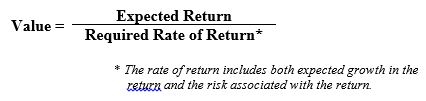
So what is the expected return? From a business appraiser’s point of view, the expected return consists of the expected future economic benefits. Think of it this way. If you were considering buying 100 shares of Apple stock for your 401K, why would you buy it? It should be obvious that you would buy it if you thought you were going to get a return on the investment – in this case a return in term of price appreciation and/or dividend payments. Similarly, an equity investor in a private company would be looking to future profits, distributions, or cash flows available to an equity holder.

Expected Return
Regarding the required rate of return, it is a general truism that the greater the risk, the greater the required rate of return. An investor wants to be compensated for taking more risk. The following chart illustrates this in the market place.
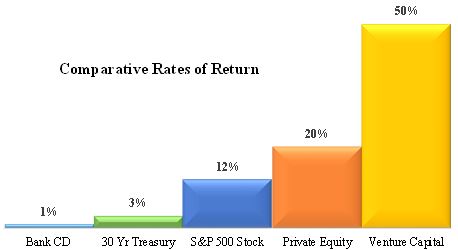
Bank CDs, which generally have short return periods – say 3 months to 3 years, pay very low rates of interest – or in business appraiser speak – have low required rates of returns. Why? There isn’t much risk. The maturity is relatively short, the bank promises to pay back the full amount of the principal, and the CD is insured by the Federal Government through the FDIC. Thirty year treasury bonds are equally guaranteed by the government so have little risk. However, they have a 30 year maturity date, so there is inflation risk – the potential that rates will rise and the investor, who has locked in a return for 30 years, will miss out on higher future interest rates. Therefore, the rate of return is higher.

Similarly, publicly traded stock and privately held stock have even higher required rates of return. There is no guarantee of value – not by the government, not by the market, and not by the company. Publicly traded companies, however, are generally larger, more established companies, have strong levels of regulatory oversight by the SEC, and a board of directors who have a fiduciary responsibility to act on behalf of equity holders, not insiders. Therefore publicly traded stock is seen, in general, as less risky than privately owned company stock. Certainly the stock in publicly held companies is more liquid. Finally, venture capitalists require much higher returns for taking risks in investing in startup companies, many of which may not have a completed product or a proven business model.

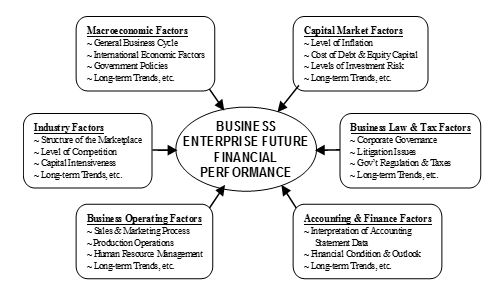
While the above returns are relatively easy to understand in terms of risk and rewards, in practice a business appraiser considers several sources of risk. For example, let’s assume a company owns and operates a chain of convenience stores with gasoline stations and makes a consistent amount of profit. Now suppose the Federal EPA requires new and improved gasoline storage tanks to reduce potential leakage and pollution that will cost hundreds of thousands of dollars to install for each location. That is now requires money to be spent on facilities that would have otherwise been available to the owners of the company. All other things equal, that loss of available funds to the owner reduces value – we have reduced the numerator in the valuation equation (above). Looking at it another way, if the business is sold and the tanks have not been replaced, the new owner will have to replace the tanks and will not pay the seller for the value derived as if the tanks had been replaced. In the same way, the following diagram illustrates many of the factors that business appraisers may consider when attempting to quantify risk.
Expected Growth
The final component in the value equation is growth. Think of growth this way: All other things equal, a company that is growing is more valuable than a company that is not – the economic benefit in the former rises over time; the economic benefit of the latter does not. It is the business appraiser’s job to estimate growth in the Expected Return. That growth may be constant, in which case the value model becomes simpler, or it may be variable, in which case a more complex valuation model may be employed to derive the value estimate.

Once the business appraiser has somewhat of a handle on these three factors, the appraiser can employ one or more of three valuation approaches, the income approach, the market approach, or the asset approach.

Let’s walk through an example by assuming a company generates an economic benefit to equity holders of $100,000. What is the value of the equity?

Value from the Income Approach
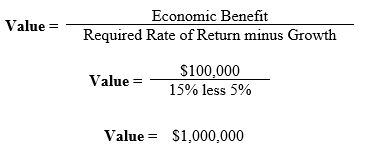
When employing the income approach there are several methods that can be used. The one following should look familiar. Let’s assume the $100,000 return to equity to holders and that the business appraiser has determined that the required rate of return associated with those equity return benefits is 15 percent. Let’s also assume that the appraiser as determined that the company will grow continually over time at a 5 percent rate. The value of the equity is $1 million, as follows:
Value from the Market Approach
Employing a market approach to value, a business appraiser will seek to find companies “similar enough” to the subject company from which it can derive valuation multiples, much akin to how real estate appraisers value homes – by looking for similar sales and adjusting compare to the subject home.

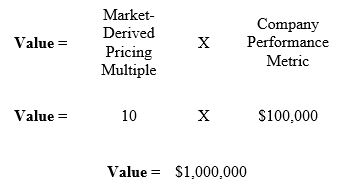
So let’s suppose the business appraiser looks in the market, whether at public companies’ trading prices or private company transactions, and derives a market multiple for the metric of 10 times. Applying that multiple to the subject company’s metric of $100,000 generates a value indication of $1 million.
Value from the Asset Approach
The asset approach simply takes the reported accounting book value of the company’s balance sheet and converts it to market value. The theory is simple:

If Book Value of Assets – Book Value of Liabilities = Book Value of Equity

Then

Market Value of Assets – Market Value of Liabilities = Market Value of Equity

Illustratively, the following balance sheet shows the accounting book value of the company with a book, or accounting value of equity of $415,000. By adjusting the book value to market value, through analysis and appraisal of specific assets, including any not reported on an accounting basis – such as goodwill or other intangible assets, the market value of equity in the amount of $1 million is derived.
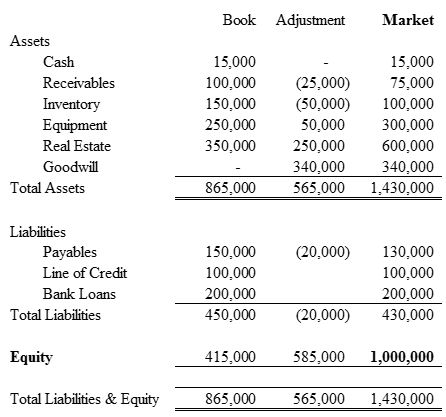
So employing the three approaches to value, income, market, and asset, all of which measure risk and returns in some way, derive a value indication of $1 million for the equity of this example company.

In addition to the above, there are a couple other concepts worth noting: level of value and standard of value.

Level of Value
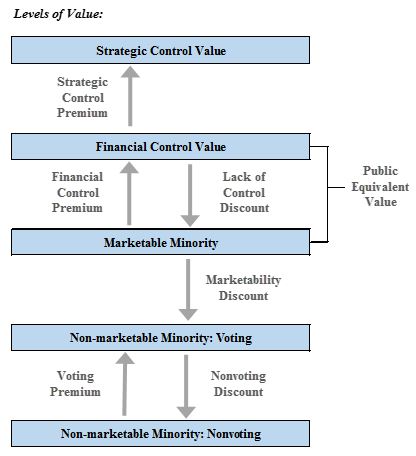
Level of value relates to the specific ownership interest that is the subject of the business appraisal. Different equity ownership interests in the same company may have varying levels of liquidity, or marketability, and control. Depending upon what is valued, adjustments for those differences must be accounted for, usually in terms of discounts or premiums. If a business appraiser’s value computations derive a control level value and their assignment is to value a non-control minority equity value of a privately held company, they will likely make adjustments to the pro-rata value for identifiable differences in the lack of control and lack of marketability as between a control interest and a closely held minority, non-control interest in the same company.

The following chart illustrates the relationships between the various levels of value.
Standard of Value

The standard of value assumed in the business appraiser’s analysis can impact the value conclusion. The standard of value will likely vary, depending upon the purpose and venue for the business appraisal. For example, the fair market value standard assumes a hypothetical buyer and seller on a financial transaction basis. If a business appraiser was valuing a non-control interest, the value conclusion would have to be on a non-control basis – and a discount for lack of control may be appropriate. However, in a shareholder litigation, statutory fair value is often the standard of value. Most state statutes and related case law require that the oppressed minority shareholder not be further oppressed by receiving value for their interest at a “discounted” basis that a control shareholder would not suffer.

Fair Market Value: Fair market value is defined as “the price at which property would change hands between a willing buyer and a willing seller, neither being under a compulsion to buy or sell and both having reasonable knowledge of the relevant facts.” Originally derived from tax-related valuations, IRS Revenue Ruling 59-60 is a great source document to understand fair market value. FMV is still applicable for tax compliance valuations, and is the basis for the standard of value in many other venues, such as divorce litigation.

Fair Value: Fair Value is a standard of value often used in statutory dissolution and oppression cases and its meaning and impact on value can vary from venue to venue. For example, it identified in New York State Consolidated Laws, Business Corporations, Article 11 – Judicial Dissolution as the basis for distribution and has generally been interpreted in the courts as a shareholder’s “proportionate interest in ‘going concern value’ of a corporation as a whole, that is, what a willing purchaser, in arm’s length transaction, would offer for corporation as operating business.” (638 New York Supplement, 2d Series / 87 NY.2d 181). There is also a different kind of “fair value” standard for financial reporting, which is defined in detail in FASB (Financial Accounting Standards Board) pronouncements.

Synergistic Value: Synergistic Value is the unique value to a particular buyer who expects returns outside, or in addition to, the returns of the business enterprise itself because of the expected synergies such as: the consolidation of back-office operations, economies of scale, elimination of competition, product or market synergies, and/or increased purchasing power.

Don’t confuse Precision with Accuracy

What’s the difference?

A few years ago an attorney asked me to review a business appraisal of a sole practitioner law practice in the context of a divorce. The report was prepared by a CPA with no valuation credentials, and who served as the accountant for the attorney/husband. The CPA calculated the value by applying an “excess earnings method.” To do so each of the practice’s assets are valued, and the return on each is estimated. Any excess earnings over the expected return on the valued assets are capitalized by a rate of return to estimate the goodwill value of the practice, which is then added to the value of the assets, net of any debt, to determine the total value of the practice. The CPA’s conclusion? The law practice was worth $108.64. The conclusion was very precise. But was it accurate?

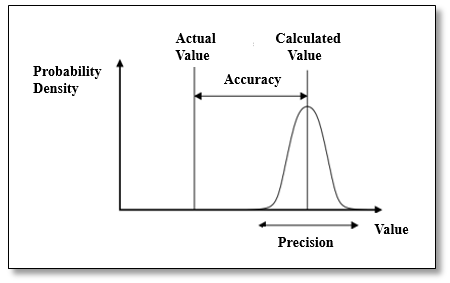
Accuracy describes the “nearness” to a true value. The closer to the bull’s-eye one is when shooting at a target, the more accurate the shot.

Precision, on the other hand, is the degree to which several measurements provide answers very close to one another and indicate the scatter of data – the lesser the scatter, the higher the precision. But preciseness does not create accuracy. Let’s go back to the bull’s-eye example. If I shoot five arrows and all of them land in the upper right quadrant in the outer ring of the target, my shooting was very precise, but I wasn’t very accurate.

Want a numbers example? Suppose I want to determine the average profitability of all restaurants in my community (and let’s assume all restaurateurs are willing to discuss the same with me). If I call five restaurants on Monday morning and calculate the average profitability down to the penny, I’m very precise in my calculation. But am I accurate? Do all restaurants tend to show the same level of profits?

Let’s look at just one factor. Many restaurants are closed on Mondays, choosing to be open all weekend. Can I assume those restaurants are similarly profitable as those that are open on Mondays? Chain restaurants typically are open 7 days a week. Locally owned, private restaurants are the ones that are most likely to close on a Monday. Fast food restaurants are generally open 7 days a week. Higher-end white tablecloth restaurants are more likely to be closed on Mondays than fast food restaurant chain stores. My sampling method assumes all types of restaurants have similar levels of profitability, but if I exclude all the restaurants that are closed on Monday, my average of the sampling may be very precise but not very accurate if my assumption about “sameness” is incorrect (and it probably is).

If we look at the issue in terms of statistics, the graph at right illustrates the difference. Let’s assume the “actual” value represents the true, intrinsic market value of our appraisal subject. The closer our value indication is to the actual value, the more accurate our conclusion. On the other hand, we may observe market data and find very little “scatteredness” in the data – statistically speaking, the coefficient of variance is very low. But if we’re observing the wrong data, even though our analysis of it implies precision, we won’t be very accurate.

Don’t be fooled into assuming that precision implies accuracy. It doesn’t. In fact, in my experience preciseness is often used to mask inaccuracy. In an appraisal, a highly precise conclusion of value causes me to double down in my evaluation of its accuracy.

To Restructure or Liquidate

When a business finds itself on the road to serious financial trouble and unable to obtain financing from new or existing sources of capital, or solve its financial problems quick enough internally, it should pursue a solution through its creditor constituencies. This can be done either out of court or with the assistance of the federal bankruptcy code. Under either of these approaches, the debtor has many alternatives in seeking relief. The appropriate approach will be influenced by a number of variables, including the debtor’s size, financial history, capital structure, nature of the problems and the outlook for the business.  In examining the options two major issues must be addressed; should the business restructure or liquidate and should the reorganization or liquidation take place out of court or in bankruptcy court?

In choosing the best alternative it is imperative to understand what caused the debtors current troubles, whether the company will be able to overcome them and, if so, what actions will be required to turn the company around. Advent Valuation, as financial advisor, canassist the Company, or its creditors, in determining how the losses occurred and what can be done to evade them in the future.

To aid in this determination, it may be necessary to forecast the cash flow of the operations for weekly periods for a term of thirteen weeks. This is one of the most powerful cash management tools. The 13-week cash flow projection is utilized by management of distressed companies to help manage and anticipate short-term liquidity needs. Advent can also be helpful in indicating where additional steps will be necessary in order to obtain positive cash flow. The best indication that a failing business has a reasonable chance for a recovery is the presence of three attributes.

  1. A core business capable of generating cash flow, preferably showing a positive EBITDA and the ability to meet future challenges
  2. A new source of funding, preferably long term
  3. A management team capable of assuming operating control of the firm

For existing clients, the information needed to choose the course of action can be accomplished with minimal additional work.  However for a new client, a review of the client’s operations will be required to ascertain the company’s situation. Once the analysis has been completed, and unless additional capital is raised or a buyer for the company is found with assistance from its advisors, the client normally makes the decision to:

  • liquidate the business
  • attempt an informal settlement with creditors, or
  • file a chapter 11 petition.

For example where a company’s product is inferior, with declining demand, inadequate distribution channels, or other problems exist that cannot be corrected (either because of economic reasons or management’s lack of ability), it is normally best to liquidate the business immediately.  Postponing a closeout strategy greatly diminishes the liquidation value if customers abandon the company and business relationships deteriorate.

Conversely, if the company is determined to be viable the decision whether it should immediately file a chapter 11 petition or attempt an out of court settlement depends on several factors including:

  1. Size of the company and whether it is public or private
  2. Number of creditors and if they are secured or unsecured
  3. Complexity of the situation
  4. Nature of the debt, prior relationships with creditor constituencies, and pending lawsuits
  5. Executory contracts, including leases
  6. Tax implications of alternative selected
  7. Capabilities of management, including mismanagement, fraud and irregularities.

In summary, hiring both Advent and a component bankruptcy attorney can help a company work through the question of whether to restructure or liquidate.  Advent Valuations Advisors is here to work through the difficult questions with you.

What’s Your Company Worth? The Art of Valuation

by Moira Vetter, Forbes Contributor

Anytime you begin discussing entrepreneurship and finance, the topic turns to valuation. Determining what your company is worth, is not unlike determining what your child is worth. (Your kid is priceless, your company isn’t…although it’s no less personal.) To the owner, the process of valuation is subjective and emotional. To the buyer, the valuation process is far more objective.

The issue of valuation comes up regularly because it matters for several reasons. Let’s take a look at how finding a reputable advisor to help you determine your value is important in these instances:

  • Valuation when you are seeking investors or capital
  • Valuation when you are seeking to bring in partners or share equity with key employees
  • Valuation when you are seeking to sell

Valuation for the purpose of seeking investors or capital

Different types of investors focus on different stages of business. If you’re at the startup phase, pre-revenue—perhaps even pre-product—you may find a startup angel. In these cases, you can’t show a historical P&L, patented technology or equipment that have a logical or quantifiable value. At this stage, a company’s ‘potential valuation’ is based heavily on the vision of the founder, their assessment of a market need, the value of that market segment or category of offering, etc. These types of early, lead angels will assign a percentage of the entire venture they are willing to take in exchange for funding. They often will develop a terms sheet that enables you to buy back or earn back your equity.

If you are a second-stage or more mature business, the tangible cast of financial instruments, audits, market sizings, sales reports, profitability trending, and more will likely be used to assign valuation. Unless there is going to be a change in ownership, at this point an investor is primarily interested in ensuring the business itself and its value or cash flow will make good collateral against their investment. Most investors, banks included, have a laundry list of items they will require from you and your CPA to review your financial health and estimate value. Make sure you are conversant with these documents, understand them, and head-off any oddities in your financials prior to being asked to see them. CPAs often can assist you with this process.

Valuation for the purpose of bringing in partners or sharing equity

The process of ‘doing deals’ is an odd one. It’s another place where the sole or majority shareholders may have an emotional, subjective view of value. The process of determining valuation is a first step here. The subsequent process of determining how shares will change hands—additional investment, earning shares in lieu of salary, etc.—is a whole different exercise. This can be made more complicated in a services business where there are less fixed assets and where individual’s worth or value to the enterprise is likewise subjective. For the purposes of valuation, there are often consultants with experience in a given sector or business type who have relevant business examples to draw on to help in assigning value. Also, larger CPA firms may have a separate department that focuses on valuation. These groups are typically separate from the CPA, similar to audit, to ensure an objective view is taken when assigning value. When a mutually agreeable value has been determined, a corporate attorney or legal consultant that focuses on private equity deals is the best person to engage to assist with the negotiation. Too often, shareholders attempt to do gentlemen’s agreements to avoid uncomfortable discussions. Now is the time to have any potential uncomfortable discussions, with independent people representing the shareholders, before the deal is done. In this way everyone begins the new partnership on the right foot, with the appropriate consideration so they can begin immediately growing the value of the collective and not arguing about the details of an equity exchange.

Valuation for the purpose of a sale

When it’s time to sell, a different group of experts is needed for valuation. You will of course need all the financial documents discussed before, ideally these have been audited by pros to start you off on stronger footing. These advisors for smaller businesses may be brokers or consultants that are expert in your sector. If your business is larger, let’s say closer to $10 Million, you will likely be interviewing investment bankers to represent you in a deal. Investment bankers have their own formulas, protocols, valuation teams and will typically pitch you on their approach to assisting you with a sale, including their rough estimates on determining your valuation. It is important to have advisors that can help you with both Fair Market Value and Investment Value. In a Fair Market Value sale, you make be talking about ‘multiples’ on your revenue and profit or comparables of other companies sold. Your assets, cash and other objective factors will be calculated. The more interesting discussions however come from the area of Investment Value. This is where most sellers get excited because the businesses’ value is viewed in relation to the prospective buyer’s gain or value from the buy. My company supported one business with their branding, lead generation and sales force effectiveness as they went through a sale. Their Fair Market Value was estimated at about $70 Million. In developing their markets and working with the investment bank, a motivated or ‘strategic buyer’ was uncovered. This buyer benefited from adding key accounts the business had, removing a key competitor that stood between them and several deals, and helped them add geographic coverage where they had no footprint. The Investor Value came in at $130M. This one example should give you major clarity on the difference between the Fair Market Value and the Investment Value of your company.

Do you know what you’re worth?

The moral of this story is that many professionals can help you do the sometimes confusing and elusive exercise of determining what you’re worth. Don’t be taken in by the first person that tells you, you are worth a fortune. Be sure to check references. And be prepared to start getting phone calls from these individuals once your revenue exceeds $3 Million.

What’s important is to know why you are determining your valuation, who stands to gain from the final figures and the expertise of those best equipped to help you determine valuation and represent you. Just remember, before you do the process of finding an expert, make sure your financial house is in order. The cleaner your books are and the more aware you are of the impacts that grow your revenue, profit and growth segments, the better armed you’ll be when the questions and document requests begin to fly.

Like the blog? Follow me here and on Twitter @MoiraVetter.
What do you think entrepreneurs want to know about managing or securing capital?

Synergistic Value vs Fair Market Value

We were recently engaged to value a national retail company because the owner wants to groom it for sale. He had received a soft offer for his business about 6 years ago. Although he wasn’t ready to sell at the time, he feels he is now ready to develop an exit strategy and wants to sell his business for the highest gain possible.

For most small businesses, the pool of potential buyers consists primarily of someone who wants to take it over and run it as it is as a stand-alone business. We call these types of buyers “financial buyers.” Financial buyers look at the fair market value (FMV) of the business. Based on Internal Revenue Service Revenue Ruling 59-60, plus 50 years of tax court rulings, FMV is defined as “the price at which the property would change hands between a willing buyer and a willing seller, when the former is not under any compulsion to buy and the latter is not under any compulsion to sell, both having reasonable knowledge of relevant facts.”

In some cases, however, a business can have qualities and features that make it attractive to larger companies for various reasons. These qualities are called synergies. The premise of “synergistic” value (or investment value) is defined as the specific value of an investment to a particular investor (or class of investors) based on individual investment requirements and expectations. For the same company at the same valuation date, the differences between these two premises of value can produce significantly different conclusions of value.
The differences between a synergistic value and a FMV premise are quantified in the following four ways:

  1. Estimates of future earning power
  2. Perception of the degree of risk
  3. Financing costs and/or tax status
  4. Synergies with operations owned or controlled

Unlike the “financial buyer” identified above, most synergistic buyers do not intend to run the business as a stand-alone business. In fact, the “synergies” by their nature create a situation where the buyer will run the acquired business in conjunction with another business or division. The synergies generally come from the anticipated consolidated operations such as:

·    General and administrative expenses
·    Costs of goods sold (volume purchasing)
·    Horizontal or vertical integration
·    Lower financing costs

No matter what the reason, the degree to which the differences identified above are quantified and used in the ultimate value conclusion (or purchase price tendered) is in large part dependent upon the willingness of a particular buyer to share in the identified synergistic benefits and how much of those benefits they are willing to pass onto the seller as a premium. Therefore, a seller side analysis without a specific buyer in mind can only offer a potential range of value and serve as boundaries for reasonable negotiating discussion points with potential buyers.

The retail business we were engaged to value has been in business for 25 years with a strong reputation within the industry. The business has been well run and does better than the industry average of its peers. There is excess cash in the business and little debt, but revenue has been flat for three years. The company is ripe for an infusion of capital to target growth beyond its current geographic areas.

A valuation of this company using the FMV premise of value, produced a conclusion of value of close to $30 million. Based on the previous soft offer and the potential growth the owner feels is inherent in the business, he was thinking the company was worth more like $40 million.

Of the four areas listed above, where synergistic value can be found, the first two could be estimated without a specific buyer in mind; estimates of future earning power and the perception of the degree of risk. We can only assume there would be additional differences once specific areas for synergy are discovered when a particular buyer is identified.

After obtaining a new set of projections for the next five years based on growth multiples that management feels is possible (given additional capital for infrastructure and marketing), we applied the company’s proven profitability ratios and created a prospective look at the financial statements to create a discounted cash flow (DCF) model. To apply the DCF method of valuation properly, we also considered and analyzed the effect of growth rate, taxes, CapX and depreciation.

The second area we were able to estimate was the degree of risk to apply to the future cash flows. Our starting point was the risk attributable to the company in our FMV analysis. In this case, it was 17.6 percent. We then researched the applicable rates of the pool of potential acquirers in the industry and found the median market weighted average cost of capital using the build-up method is 10.6 percent. This is quite a difference. What it means is, a potential acquiring company from this pool of identified companies, has room to work in a “premium” to be paid to the seller by way of sharing some of the benefit of its lower risk rate in the deal.

Knowing these factors, we were able to calculate DCF models that demonstrate synergistic value scenarios for the company close to what the owner was hoping for. This range of values now becomes his “playing field” as he works to make the company an attractive target for a potential buyer.

Valuing Intellectual Property

The nature of big business has changed dramatically over the years. Up through the 1970s in the US most big business was manufacturing oriented, including the distribution of manufactured products (wholesalers and retailers). These types of businesses are tangible asset heavy – they own real estate, manufacturing facilities, distribution assets and the like. In fact, these types of assets accounted for nearly 80 percent of the total market capitalization (value of the S&P 500 companies in 1975 – leaving only about 20 percent of the market capitalization associated with intangible assets – including intellectual property (or “IP”).

Today that is not the case. Many of the big manufacturers are gone – either completely or off-shored to manufacturing facilities in China and other countries. The big publicly traded companies today are technology, communication and media companies – all of which depend on tangible assets to a much lesser extent than their predecessors. So much so that the proportion of tangible assets attributable to the market capitalization of the S&P 500 companies today are represent less than 25 percent of the total. That means the balance, or 75 percent or more of the market capitalization, is associated with intangible assets, including intellectual property.

But intellectual property does not exist solely in the domain of big business. Small businesses, professionals, artists, musicians, and other similar individuals and entities can call generate valuable intellectual property.

What is intellectual property? The World Intellectual Property Organization (www.wipo.int) defines intellectual property as “creations of the mind, such as inventions; literary and artistic works; designs; and symbols, names and images used in commerce.” Most people think of patents, trademarks, copyrights, and similar items as IP – and they are correct. These types of IP items are “statutory” in nature. That is, they exist because of some legal construct. Someone can patent an invention at the US Patent Office (or one or more of many governments) and obtain legal protection against infringement by others attempting to use the same invention without permission.

Often the owner of IP will license its use to third parties on some basis. This is referred to as licensing the IP. Such licensing can be unlimited in scope or limited in terms of time, exclusivity, or application.

There are many reasons for valuing intellectual property, including to support a transaction of IP, the valuation of IP for accounting and financial reporting purposes, for estate planning, and in the context of a litigated dispute.

Many will remember the case – and subsequent movie, “Flash of Genius” (2008) – where Robert Kearns takes on the Detroit automakers who he claims stole his idea for the intermittent windshield wiper. He had tried to license the technology to all the Detroit auto makers in the 1960s but was turned down. Even so, the automakers introduced the intermittent windshield wiper in 1969. After a very protracted series of lawsuits, Mr. Kearns eventually won more than $30 million.

Advent has been valuing IP for more than 20 years, including patents, copyrights, royalty contracts for movies and TV shows, famous musician’s record catalogs, brand names, software, and customer, advertiser, and patient lists. What do we need to know to value these types of assets? While that may vary from type of IP to type of IP, here’s a list of things we almost always need to know:

  • Who owns the IP? Is the owner is an individual or entity? Sometimes we are asked to value the IP. Other times we are asked to value a specific, and oftentimes limited, interest in the IP. Ownership structure and rights impact value. The legal documents identifying ownership and rights to the IP should be made available.
  • Has the IP been published, patented, or registered? IP without protection is more vulnerable to third party exploitation, adding an element of risk and potentially impacting value dramatically.
  • What is the economic life of the IP? Not to be confused with statutory life, which is determined by law or statute, the economic life is a key driver of value. Take patented micro-chips for cellular phones, for example. While they may have a 20 year statutory life, the useful, or economic, life may only be two years or less – until a better, more advanced featured chip is developed.
  • Are royalties currently or historically being received? If not, it’s possible that the IP is not a valuable asset. Alternatively, what are the potential uses for the IP and are the alternative IPs that are essentially competitive to the IP? The answer to this question helps identify the potential economic benefit that could be generated by the IP.
  • Is the future income stream fixed or variable? A variable income stream is riskier because it depends on certain conditions to occur that may not. A fixed fee agreement is paid regardless of potential exploitation occurring or not. A “percent of revenue” licensing arrangement ties the licensing benefit directly to future – and unknown – sales success. At the end of the day, the value of IP is based upon the economic benefit it generates to the holder of the IP. Related, if there are additional expenses associated with perfecting or exploiting the IP, such will likely impact value.
  • What development costs are needed to optimize revenue? Most licensing agreements are based on a percentage of revenues or a fixed amount of units sold. If the additional costs to commercialize are unduly high, the licensee(s) may not be willing pay these costs as the deal may end up being uneconomic for them. Think of this in these terms: would you pay the same price for a partially completed house as you would if it was fully finished?
  • Do the rights to exploit the IP expire or are they perpetual? Statutory rights don’t last forever, and the duration depends on the nature of the property. Regardless, the licensing arrangement can be open ended or have a specific term.
  • If the IP is a patent, how solid is its claim? What is the probability that others will claim it infringes on their patents. Such impacts risk and value.

Valuing IP is very fact specific, both to the type of IP and the characteristics of the IP; legal, operational, contractual, and financial. These types of questions – and others – help Advent professionals identify the inputs necessary to develop an opinion of value.

Questions? Call us at 845.567.0900 or 212.308.4151

Is This Tech Bubble Less Scary?

In our minds, a recent Wall Street Journal Article entitled “Why This Tech Bubble Is Less Scary” by Christopher Mims is reason enough to believe that the tech bubble just might be as scary as 1999. Those of us old enough to remember Alan Greenspan’s infamous warning that the “markets are suffering from irrational exuberance” are hopefully wise enough to recognize the signs. Arguing that such exuberance doesn’t exist doesn’t make it go away.

We do valuation for a living. We study it, analyze it, report on it, teach it, and testify on it. All day. Every day. For years before the 1999 Dot Com Bubble Bust.

And it’s valuation that drives investment decisions. Decisions to buy. Decisions to hold. Decisions to sell.

Valuation, at its core, is simple. Value equals expected returns divided by the net of expected risk and expected growth in those returns. For example, if expected returns are $1,000 and risk (as measured by a required rate of return) is 15% and growth is expected to be 5%, then the value is $10,000 ( or [$1,000 ÷ (.15 – .05)], simplified to [$1,000 ÷ .10] ). The models we use are more complex to deal with more complex situations but the concept is exactly the same.

So when rational investors are looking for increased value, they are looking at some combination of increased returns, decreased risk, or increased growth.

Most, though, don’t look at valuation in these terms. Rather, the investor community talks about market multiples. A price/earnings multiple of 20 times, for example, is a good buy when the multiple is expected to grow to 25. What many don’t realize is that a market multiple is simply the inverse of a capitalization (or cap) rate. The cap rate is calculated by subtracting growth from risk. In the example above, the cap rate is 10% (or 15% less 5%). That converts to multiple of 10 times. In the market, illustratively, Apple (APLL), whose phenomenal profit margin of 22.5%, trades at about a 12.8 forward price/earnings multiple.

As business valuers, our job is to identify from various sources of empirical and non-empirical sources expected returns, risks, and growth in a particular company, investment, or asset. We use that evidence to derive a value estimate.

In this context, then, what was the irrational exuberance Mr. Greenspan spoke of? In 1999, it was the irrational expectation that growth would continue unabated. That irrational analysis led investors to assume that even if dot coms – the tech companies of that day – did not show any economic returns, now or in the foreseeable future, that the growth was so strong and so great, that once returns did materialize, the values would be so high that even high risk ventures seemed a bargain.

And almost like musical chairs, the greater fool theory kicked in and everyone ratcheted up their investments’ expectations. Then the music stopped. Growth, it turned out, would not continue unabated. Values plummeted, investors sold if they could, and people paid the price for their irrationality. But it wasn’t just tech that was impacted. The equity markets as a whole were impacted.

Fast forward to 2007/2008. Another stock market correction. This time driven by the banking and investment banking industries who again forgot basic valuation theory. This time, they – and the investor community – forgot to estimate risk. In fact, the complex securities created in the early 2000s were so complex, most weren’t even sure how to tag a risk premium to them. Add to that government guarantees provided by Freddie Mac, Fannie Mae and other entities, and the market again behaved irrationally – until it came to its senses, saw the risk, and corrected itself immediately – to the great angst of investors and taxpayers, the latter of which bailed out the banking industry. But it wasn’t just banking that was impacted. The equity markets as a whole were impacted.

So where does that leave us in 2015? Mr. Mims says that if we’re in a bubble, it’s nothing like 1999. We’re not so sure. In 1999, investors were pricing tech startups by a “click through” multiple – implying growth, not profits were important. Today, pre-public company deals are priced and transacted in terms of revenue multiples, which implies profits are not important. Grow the top line and grow the value.

For example, we recently valued a tech company that provided a SaaS-based CRM (customer relationship management) product. We looked a 6 publicly traded companies in that market space. Four out of the six have never shown profits. The largest, with a market cap of $46 billion (yes billion) has never shown a profit. Their valuation averaged 8 times revenues (not earnings), with two of the six at double digit multiples. The six average $1.2 billion in revenues and a market cap of almost $10 billion. None are forecasting any meaningful profits.

Compare that to Apple, with its way above market returns, it trades at 3.4 times revenue. And that’s a healthy multiple when compared to AT&T (T) at 1.4 times revenue or Ford (F) at 0.4 times revenue.

Going back to the price/earnings multiple, for these six companies, if we assumed a much better than actual normalized profit margin of 12 percent, that would translate to a price/earnings multiple of nearly 100 on average. That’s 800 percent more than Apples price/earnings mutliple.

Mims’ point that the bubble is not as big is accurate, but only as far as his explanation goes. Transaction pricing based on unsustainable multiples for these companies filter into the market as investors and their advisors value the future exit prices on irrational multiples that cannot be maintained or on profits that have never been proven are not nearly as large a portion of the market as they were in 1999.

However, a rising tide raises all ships. Including all the retirement money in the market today that wasn’t there in 1999.  So just as we’ve seen twice in the last 15 years, it’s not just tech that will be impacted when the bubble bursts. Regardless of the size of the bubble,the equity markets as a whole will be impacted.

IRS Releases New S-Corp Valuation Job Aid

The 2001 decision of Gross v. Commissioner (Gross v. Commissioner, T.C. Memo. 1999-254, affd. 272 F.3d 333 (6th Cir. 2001)) fundamentally changed the manner in which valuation experts and the Tax Court treat valuations of S corporations (S-Corps).` In this decision, the Tax Court accepted a valuation report proffered by the IRS that determined that S-Corp shares, are fundamentally more valuable than C corporation shares due to the unique tax characteristics of S-Corp.

Before Gross, business valuation experts for both the Internal Revenue Service and taxpayers typically valued S-Corp that tax affected earnings to measure income for valuation purposes. However, since Gross, the Tax Court has been consistent in its rejection of this valuation practice. Rather, the Tax Court has accepted valuations which remove the imputed corporate taxes from the valuation analysis, causing a significantly higher value indication of the S-Corp; sometimes by as much as 60 percent or more.

Emboldened by Gross and subsequent decisions on this issue, the IRS continues to challenge taxpayers submitting S-Corp valuation reports which fail to properly address the tax-affecting issue. With over 4 million S-Corp in existence, the impact of this development has significant consequences to taxpayers.

Just released, an internal IRS document reveals the agency’s most current thinking on the valuation of S-Corps. While the document was written to help IRS professionals who are examining S-Corp appraisals, it presents a wealth of information for appraisers, estate planners, and holders of S-Corp shares.

Entitled: “Valuation of Non-Controlling Interests in Business Entities Electing to be Treated as S Corporations for Federal Tax Purposes: A Job Aid for IRS Valuation Analysts,” we’ve provided a copy of it for your review. Just click here to obtain a copy.

And feel free to contact us at Advent Valuation Advisors to help you address this and other complex business valuation issues.

Discount for Lack of Marketability (DLOM) in NY Fair Value

DLOM’s in New York statutory fair value cases continue to be a highly unsettled issue. Following are just three cases (we’ve already commented on Zelouf, but it is worth mentioning here in context) that identify either no DLOM or some sort of DLOM. Note that clicking on the case title will provide you with the court’s ruling.

In my opinion, it is unfortunate that experts have contributed to the confusion by referencing market studies of non-control market data for DLOMs without connecting the dots between control and non-control issues. Certainly in NY, as in most states, any discount or adjustment for lack of control – essentially penalizing the plaintiff non-control interest just for the nature of the non-control interest – to the benefit of the control interest is not allowed. Market evidence for DLOMs for non-control interests can be significant – as much as 60 percent or more. But are such discounts appropriate for controlling interests? Or in the case of fair value, the pro rata share of a control interest? Certainly the Courts don’t believe so, but they are often left to their own devices to rationalize some sort of illiquidity adjustment, often on an intuitive basis, rather than relevant facts and evidence provided by experts.

Zelouf v. Zelouf, 2014 N.Y. Misc. LEXIS 4341 (Oct. 6, 2014)

Nahal Zelouf obtained a 25 percent interest in the family-run textile business from her husband after he fell into a coma. The other owners included her brother-in-law and her nephew, the latter of which who had a majority stake. In 2009, Nahal made a books and records request and subsequently sued the other owners for waste and misappropriation, alleging that the two men plundered the company for their personal gain. The Court excluded the application of a Discount for Lack of Marketability (or DLOM). Regarding such, Justice Kornreich wrote:

[N]o New York appellate court has ever held that a DLOM must be applied to a fair value appraisal of a closely held company. On the contrary, the Court of Appeals has held that ‘there is no single formula for mechanical application.’ Matter of Seagroatt Floral Co., Inc., 78 NY2d 439, 445 (1991). Indeed, the Court of Appeals recognizes that ‘[v]aluing a closely held corporation is not an exact science’ because such corporations ‘by their nature contradict the concept of a market’ value.”

Giaimo v. Vitale, 2012 NY Slip Op 08778 (1st Dept Dec. 20, 2012)

The entity that was  the subject of the litigation owned 18 Manhattan tenement apartment buildings and one land parcel (for a total value of $85 million). One of the appealed issues was the appropriateness and size of a DLOM. There had been several year’s of case rulings that held that no DLOM was appropriate for real estare holding entities – that DLOMs were more appropriate to intangible goodwill values associated with operating companies. However, the Appellate Division, First Department wrote, “While there are certainly some shared factors affecting the liquidity of both the real estate and the corporate stock, they are not the same. There are increased costs and risks associated with corporate ownership of the real estate in this case that would not be present if the real estate was owned outright. These costs and risks have a negative impact on how quickly and with what degree of certainty the corporations can be liquidated, which should be accounted for by way of a discount.” Consequently, the Court determined a 16 percent DLOM in this case based, not on empirical evidence regarding DLOMs appropriate in this case, but on a “build up” method that layered costs of creating liquidity profferrd by one of the trial experts.

Chiu v Chiu, 2015 NY Slip Op 01427 (2d Dept Feb. 18, 2015)

The Appellate Division, Second Department upheld without comment a lower court’s decision to apply 0 percent DLOM (or no DLOM) in valuing a membership interest in a realty-holding LLC co-owned by two brothers, but unfortunately provided no supporting discussion. The underlying case involves a dispute between two brothers regarding an LLC formed in 1999 to acquire a warehouse. The brothers never executed a written operating agreement but the LLC’s 1999 and 2000 tax returns identified one brother as 25 percent member and the other brother as 75 percent member in proportion to their initial capital contributions. No tax returns were subsequently filed because of the brothers’ falling out in 2001 that led to multiple lawsuits over the ensuing several years.

Finally, after years of litigation, in 2008 the minority member exercised his statutory right to withdraw from the LLC and receive fair value for his 25 percent membership interest. the control member contended that his brother had no membership interest or, at best, had an approximate 10 percent interest based on their relative, aggregate capital contributions including monies contributed solely by controlling member after the falling out.

Regarding the applicability of a DLOM, the court eventually ruled, “[The minority member] is not entitled to a lack of marketability discount. It is true that in determining the fair value of a limited liability company, as with a close corporation, the illiquidity of the membership interests should be taken into account. While the application of a lack of marketability discount is not always limited to the goodwill of a business, in the case at bar, the LLC’s business consisted in nothing more than the ownership of realty which is easily marketable. In any event, [the expert’s] testimony that [the minority member] is entitled to a whopping 25 percent lack of marketability discount for what is essentially real property placed in a limited liability company package has no credibility, and the record does not permit the court to determine what lesser percentage might be appropriate.”

New York DLOM Ruling: Discount for Lack of Marketability not “Mandatory”

Zelouf v. Zelouf, 2014 N.Y. Misc. LEXIS 4341 (Oct. 6, 2014)

When it comes to valuing a closely held company, New York law allows for the use of a marketability discount, and many times courts have applied it. But is it mandatory? This was a key issue in a recent New York ruling in a fair value proceeding.

Backstory: Nahal Zelouf obtained a 25% interest in the family-run textile business from her husband after he fell into a coma. The other owners were her brother-in-law, Rony Zelouf, and her nephew, Danny Zelouf, who had a majority stake. In 2009, Nahal made a books and records request and subsequently sued Danny and Rony for waste and misappropriation, alleging that the two men plundered the company for their personal gain.

During pretrial proceedings, in 2013, the parties jointly hired a neutral appraiser to perform a valuation of the company for mediation purposes. However, instead of settling the case, Danny and Rony pursued a freeze-out merger, forming a new company for the purpose of buying out Nahal and rendering her unable to pursue her derivative claims. Ultimately the court allowed the merger on condition that the court would rule on Nahal’s derivative claims as part of an appraisal proceeding and would allow for additional damages and legal fees if she won on those claims.

Probability of sale: Nahal rejected the company’s $1.5 million buyout offer, and the appraisal proceeding went forward. Both sides agreed that the neutral valuator’s appraisal should serve as the starting point of their analyses of what the fair value of Nahal’s shares was. At trial, the parties’ own experts focused on critiquing and adjusting the neutral appraiser’s report.

Although many courts have applied a DLOM, “no New York case stands for the proposition that a DLOM must be applied to a closely-held company,” 

The appraiser used the capitalization method under an income-based approach to determine the company’s fair value as a going concern on a controlling, marketable basis. After making normalizing adjustments to the company’s net income, he arrived at a value of approximately $8.9 million. In the alternative, he calculated the value on a controlling, nonmarketable basis, using a 30% DLOM, to arrive at a $6.2 million valuation.

The DLOM became a flashpoint. According to the neutral appraiser, “typically, a [DLOM] is usually only applicable for valuations of minority interests in closely-held companies under the assumption that a controlling owner would be able to force the sale of the company.” It was inappropriate in this case, he said, but he applied it at the direction of counsel. The parties’ experts argued over its application and the percentage it should take. In essence, Nahal’s expert maintained that under case law a DLOM was never applicable in this scenario; however, if the court allowed for one, it should not be more than 15%. The company’s expert contended New York law required a DLOM.

The court found Nahal’s expert cited the wrong case, but it agreed that a DLOM was inappropriate here. The idea underlying a DLOM is that the recovery of a frozen-out, minority shareholder should be less to account for the difficulty of selling a closely held company, especially in a niche business, as compared to a publicly traded company, the court explained. This rationale did not apply here, the court found, agreeing with the neutral valuator. It was unlikely that the company would or could ever be sold. A liquidity risk in this instance was “more theoretical than real,” said the court. Risk was “a function of probability times the threatened harm.” Here, although there would be harm in the form of a lower net purchase price, the probability that it would actually occur was “negligible.” In the absence of a risk, a DLOM was inappropriate. Although many courts have applied a DLOM, “no New York case stands for the proposition that a DLOM must be applied to a closely-held company,” the court said with emphasis. Based on the neutral appraiser’s valuation, it awarded Nahal $2.2 million for her 25% interest in the company and another $2.2 million based on her derivative claims.

The court in this case hitches the application of a DLOM to the probability of a sale. In his analysis of the case, Peter Mahler, in his blog, raises important questions about the wider implications of the court’s rationale for DLOM. Does it undermine the use of a DLOM in instances where a company is not for sale in the foreseeable future? As he sees it, “[s]uch a conclusion would rule out DLOM in most if not all fair value cases.”

I contend, and have testified accordingly, that many experts wrongly develop a DLOM in NY Fair Value cases, using market evidence for DLOMs for minority, non-control interests. Doing so, without empirically supporting equivalency between DLOMs for control interests and DLOMs for non-control interests, likely penalizes the oppressed shareholder for being a minority shareholder – which conflicts with case law that says otherwise.